Key takeaways
Not the legal side, that stays identical. What's different is the couple. People marrying later in life tend to plan with more clarity, drop the traditions that don't actually fit them, and want a ceremony that reflects a full life already lived rather than a fresh start.
Something's shifting in the wedding world, and I love it.
While younger couples are waiting longer to get married, or skipping it altogether, couples over 50 are walking up the aisle with a level of clarity and confidence I don't see nearly as often at 25. I've started calling it the Silver Celebration, and it's not really about age. It's about choice.
These weddings aren't happening because it's "time" or because everyone expects it. They're happening because two people decided, deliberately, that they want to make it official. That difference shows up in almost everything, the guest list, the vows, even the way couples talk to me in our first meeting.
I'm marrying more couples in their 50s, 60s and 70s than I was even five years ago, and it's not a fluke.
Most of the couples I sit down with at this stage have already lived a full life. Long marriages, long relationships, kids, sometimes grief, sometimes a divorce they came out the other side of stronger. So when they finally decide to marry, it's rarely about starting something new. It's about adding a proper, official chapter to something that's already rich.
A few things are driving it:
It's not just something I'm noticing anecdotally, the Australian Bureau of Statistics backs it up.
| What's changed | The detail |
|---|---|
| Second marriages | Around one in four marriages in Australia now involves at least one partner who's been married before, according to the Australian Institute of Family Studies' analysis of ABS marriage data. |
| Median age at divorce | Now 47.3 for men and 44.4 for women, the oldest it's ever been. That means a huge number of people are becoming newly single right around the age where a second, more considered wedding starts to make sense. |
| Median age at first marriage | Climbed to 32.9 for men and 31.2 for women, up from the early 20s just a few decades ago. People are simply arriving at every marriage milestone later than they used to. |
A wedding at this stage doesn't feel like a smaller version of a 25-year-old's big day. It feels calmer. More considered. And genuinely less concerned with impressing anyone in the room.
Worth saying too, "over 50" covers a lot of ground. A couple in their early 50s might still have teenagers at home and full-time jobs. A couple in their late 60s might be newly retired and planning their first overseas trip together. I try not to treat either group the same way, because their ceremonies usually want to say very different things.
Couples at this stage have generally worked out what they actually value, which means fewer decisions made out of obligation and more made because they genuinely reflect the two people standing in front of me. An intimate ceremony with twenty guests can carry just as much weight as a hundred-person reception, because the size of the day isn't standing in for how much the relationship matters.
Older couples are often the ones most willing to drop the traditions that don't actually fit them. Walking each other down the aisle instead of being "given away." Skipping a bouquet toss that assumes a room full of single women. Writing vows that acknowledge a previous marriage, or a late partner, honestly, instead of pretending the story started today.
None of that makes the ceremony lighter. If anything, cutting the traditions that don't fit tends to make more room for the ones that do, a ritual with real personal history, a reading chosen because it means something specific to them, or just more time spent actually telling the story of how they met.
For a couple celebrating a Silver Celebration, my job is a fair bit deeper than reading a script and signing a certificate. It's helping tell their story properly.
These ceremonies are shaped by years of shared history, family, and life experience, so my role is making sure the day feels like them, not like every other wedding I've done that week. In practice, that means:
I'll be upfront, I like a relaxed, easygoing ceremony with a good laugh in it somewhere. But I take the legal and emotional weight of what I'm doing seriously, and that combination tends to be what people are actually after when they book a celebrant at this stage of life.
By the time people reach their 50s and beyond, they've lived through enough that it naturally shows up in the ceremony.
I see it in the stories of how couples met later in life. In the way they acknowledge past chapters without dwelling on them. In the genuine involvement of kids and grandkids, not just for a photo. And in vows that talk about growth and resilience instead of promises about a fairytale.
That's what gives these ceremonies their weight. Nobody's selling the room an idealised version of love. Two people are just telling everyone, honestly, what they've actually learned about it.
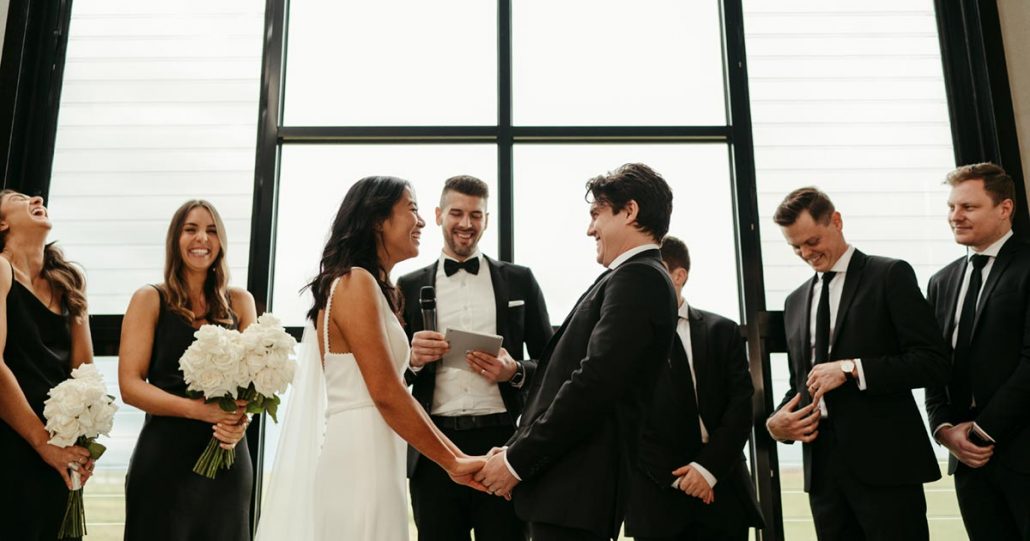
One of my favourite things about these weddings is how included the guests feel. They're not just watching, they're part of it.
Simple ways I see this work well:
A child or grandchild doing a reading.
Shared during the ceremony itself.
A sand blend or candle lighting.
A grandchild carrying the rings up.
Done well, it turns the ceremony into something the whole room shares in, not something they sit through.
Planning a Silver Celebration usually comes from a different place. Instead of chasing the "perfect" wedding everyone expects, most of the couples I work with are focused on a day that actually reflects them. More life experience tends to mean less second-guessing.
What I see couples prioritise:
Honestly, mature couples tend to plan with more confidence and a lot less anxiety about getting it "right." They build the day around what actually matters, and let the rest go.
Some couples want the ceremony itself to be a bit more interactive. A short trivia segment about the couple, for instance, gets guests laughing and actually participating rather than just watching, and I've written a fair bit about how that works in one of our past ceremonies.
It's not about turning the ceremony into a game show. It's about getting the room involved in the story instead of just observing it.
If there's one thing that defines a Silver Celebration, it's honesty. These ceremonies aren't more elaborate than a first wedding, they're just more real.
Couples at this stage know what commitment actually looks like day to day. They value companionship over performance and speak from experience rather than expectation. There's a lot less "happily ever after" and a lot more genuine partnership, and that's usually what gets the room, guests included.
This isn't a passing fad, it's a genuine shift in how people think about marriage. As expectations loosen up, more couples are choosing to celebrate love the way that actually suits their life, not the version they were handed.
That means more personalised ceremonies, more demand for relaxed, flexible celebrants, more visibility for later-in-life weddings, and less pressure to follow tradition just because it's tradition. It's a part of the industry I'm genuinely glad to be part of right now.
Every ceremony written from scratch, shaped by your actual story. Popular dates book out well in advance.
Check Pete's availabilityThe Silver Celebration isn't about doing weddings differently for the sake of being different. It's about doing them honestly.
A wedding over 50 is shaped by experience, planned with intention, and built on real connection. With the right celebrant, it can be personal, properly meaningful, and unmistakably yours. In a lot of ways, that's what weddings were always supposed to be.
If you're planning a Silver Celebration of your own and want a ceremony that actually sounds like you, get in touch and let's have a chat about your day.
A friend or family member can absolutely be part of the day, a reading, an MC role, standing up with you, but they can't legally marry you unless they're an authorised marriage celebrant. I'm the one responsible for making sure the marriage is legally valid, no matter how relaxed the ceremony feels. This trips a lot of couples up, they assume a second or later-life wedding has looser rules. It doesn't. The legal side is exactly the same whether it's a first wedding at 25 or a fourth at 65.
The big one is the Notice of Intended Marriage, or NOIM, which has to be lodged with your celebrant at least one calendar month, and no more than 18 months, before your wedding date. I also need to physically sight your original ID documents (or, for remote couples, see the originals during a live video call, a photo or scan isn't enough). If you've been married before, I'll need evidence that marriage ended, a divorce certificate, decree, or death certificate. None of that changes because you're marrying later in life, but it's worth locking in your celebrant early so the paperwork doesn't hold up your date.
Search their name on the Register of Marriage Celebrants at marriage.ag.gov.au. It's run by the Attorney-General's Department and lists every Commonwealth-registered celebrant in the country. If someone offering to marry you isn't on it, they're not legally able to.
The ceremonies that get this right give family a genuine role, not a symbolic one. A grandchild carrying the rings, an adult child doing a reading they picked themselves, a moment where the couple actually acknowledges what the blended family has been through together. What doesn't land as well is a "family moment" wedged in because it's expected. I'd rather talk it through with you first and only include what's actually true for your family.
The structure's the same, the tone usually isn't. Couples marrying after divorce or the loss of a partner often want the ceremony to acknowledge that honestly, rather than pretend it didn't happen, without tipping the whole day into something heavier than it needs to be. I'll always talk this through beforehand and help find the words that respect the past without letting it take over the day you're actually there for.
There's no requirement to use traditional vow wording at all. Plenty of couples marrying later in life go shorter, funnier, or a lot more specific to their own relationship than a standard template allows. Some want to write every word themselves, others would rather I carry more of the ceremony. Both are completely normal. The only actual legal requirement is a short declaration each partner makes during the ceremony, which I'll walk you through.
Genuinely, there's no standard answer, and that's the point. Some couples want an intimate ceremony with a dozen close family and friends, others want the full celebration with decades of friendships in the room. What matters more than size is whether the day reflects how you actually live, an outdoor ceremony for a couple who love the coast, a quiet backyard gathering for a couple who'd rather put the budget toward the honeymoon. A twelve-person ceremony can feel just as considered as a hundred-person one.
I'd say six to twelve months out, partly to lock in your date and partly because the NOIM still needs to be lodged at least a month before the wedding no matter when you book. If you're planning something smaller or more spontaneous, it's still worth checking availability early. Celebrants who do relaxed, personal ceremonies well tend to book out.
Get in touch even if your date is still a year or two off.
Get in touch with Pete